NBA Betting for Beginners: Your First Steps Without Costly Mistakes
 Available in US
The NBA Generates More Betting Action Than Any Other Basketball League — Here Is How to Start Without Burning Cash
My first NBA bet was a five-leg parlay on a random Tuesday night in November. I picked five favourites, all on the moneyline, convinced that sheer volume of “obvious” winners would print money. Every single leg lost. That was nine years ago, and the lesson cost me about forty quid — cheap tuition, looking back. See also betting tips basketball nba for the complete NBA betting tips guide.
Basketball accounts for roughly 15–18% of all global betting activity, and in the United States that share climbs above 30% during the regular season. The NBA runs 1,230 regular-season games spread across six months, which means the volume of betting opportunities dwarfs almost every other league on the planet. For a UK punter stepping in for the first time, that volume is both the opportunity and the trap. More games means more chances to learn — but also more chances to bleed cash before you understand what you are doing.
This guide strips NBA betting back to essentials. No jargon avalanche, no pretence that you will become a sharp overnight. Just the three markets you need to know, a bankroll framework that actually works, and the five mistakes I watch beginners repeat every single season. If you have never placed an NBA bet — or placed a few and watched your balance evaporate — start here.
Three Core Markets Every Beginner Must Understand
Walk into any UK bookmaker’s NBA section and you will see dozens of markets per game. Ignore most of them for now. Three markets carry the vast majority of handle, and understanding these three gives you a foundation for everything else.
The Moneyline: Who Wins, Full Stop
A moneyline bet is the simplest wager in basketball. You pick which team wins the game. No margin, no handicap — just the result. In decimal odds, which is what most UK platforms display by default, a moneyline of 1.40 on the Boston Celtics means a ten-pound stake returns fourteen pounds if they win. The catch is obvious: heavy favourites pay very little. Backing a team at 1.15 night after night feels safe until a single upset wipes out weeks of thin profits.
For beginners, moneylines work best on games where the margin between teams is narrow — odds in the 1.70 to 2.20 range, where neither side is a prohibitive favourite. You get a meaningful payout without requiring a miracle.
The Point Spread: Levelling the Playing Field
The spread is the NBA’s most-wagered market, and it exists because bookmakers need balanced action on both sides. If the Golden State Warriors are six points better than the Charlotte Hornets on paper, the bookmaker sets a spread of -6.5 for Golden State. Backing the Warriors at -6.5 means they must win by seven or more for your bet to land. Backing Charlotte at +6.5 means the Hornets can lose by up to six points and your bet still wins.
Home court advantage typically adds 2–3 points to a team’s spread, so a squad that would be -4.5 on a neutral court becomes -6.5 or -7.5 at home. That adjustment is baked in before you ever see the line. If you want to understand how NBA spreads are built and where to find value in them, that is a separate deep dive — but for now, just know that the spread is designed to make every game roughly a coin flip in the eyes of the market.
Totals: Over or Under the Combined Score
A totals bet — also called over/under — asks whether the combined final score of both teams will land above or below a number set by the bookmaker. A typical NBA total sits somewhere around 215–230 points depending on the matchup. If the line is set at 222.5 and the game finishes 112–108, the combined score is 220, and the under wins.
Totals are driven by pace — how many possessions each team generates per game. Two fast-paced offences push totals higher; two grinding defensive teams push them lower. Beginners often ignore totals entirely and focus on picking winners, but the totals market is where some of the most consistent edges live, because pace data is publicly available and relatively stable from week to week.
Setting Up Your First Bankroll: The 50-Unit Starter Model
Here is the conversation I have with every beginner who asks me how much to start with: “Pick a number you would be comfortable losing entirely. Not a number that would sting — a number that would not change your week.” For most people in the UK, that lands somewhere between fifty and two hundred pounds. Whatever that figure is, divide it by fifty. Each slice is one unit.
A hundred-pound bankroll split into fifty units gives you two-pound units. Every bet you place is one unit — no exceptions, no “I feel really confident about this one so I will triple it.” Flat staking at one unit per bet is the single most protective habit a new bettor can adopt. It keeps you in the game long enough to learn whether your approach has any edge at all.
Why fifty units and not twenty or a hundred? Twenty units disappears in a bad week even with decent picks — variance in the NBA is brutal, and losing streaks of eight or ten bets happen to competent handicappers. A hundred units sounds safer but often means your unit size is too small to feel meaningful, which leads to the temptation of bumping stakes on “certain” games. Fifty sits in the middle: enough cushion to absorb losing runs, enough per-unit weight to keep you disciplined.
In 2025, legal US sportsbooks processed $165.58 billion in handle — a record. That enormous pool of money moves through sharp and recreational bettors alike, and the recreational side funds the industry. The moment you start treating your bankroll as disposable entertainment rather than a fixed resource with rules, you join the group the bookmakers love most. Structure protects you from yourself.
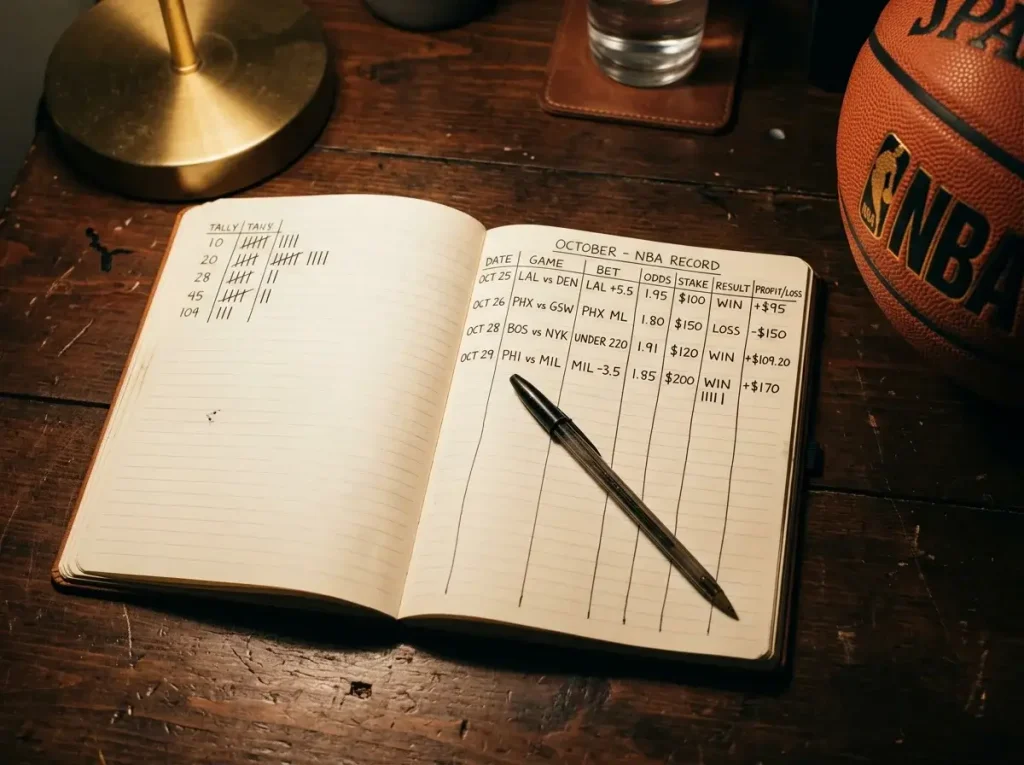
One more rule: track everything. Date, game, market, odds, stake, result. A simple spreadsheet is enough. After fifty bets you will have data. After two hundred you will have a trend. Without records, you are guessing whether you are improving — and guessing is what got most beginners into trouble in the first place.
Five Mistakes That Wipe Out Beginner Bankrolls in Weeks
I have watched hundreds of new NBA bettors crash and burn over nine years, and the pattern is almost always the same. The specific teams change, the season changes, but the errors are identical. Here are the five that do the most damage.
Betting every game on the slate. The NBA schedules up to fifteen games on a busy night. New bettors feel obligated to have action on all of them, as if leaving a game unbetted is a wasted opportunity. It is not. Most games offer no edge whatsoever. The sharp bettors I respect most bet two or three games per night at most, and frequently bet none. Selectivity is the first filter that separates losing bettors from surviving ones.
Chasing losses with bigger stakes. You lose three bets in a row and the instinct screams to double the next one to “get back to even.” This is how fifty-unit bankrolls vanish in a single evening. Variance does not care about your frustration. If your standard bet is one unit, it stays one unit whether you are up ten or down ten. The moment you deviate, you are no longer following a system — you are gambling emotionally.
Ignoring the odds and focusing only on the pick. A beginner might ask, “Will the Lakers win tonight?” That is the wrong question. The right question is, “Are the Lakers worth backing at these odds?” A team can be likely to win and still be a terrible bet if the price is too short. Implied probability is the bridge between “I think they win” and “this bet has value,” and most beginners never build that bridge.
Loading up on parlays. Parlays — or accumulators, as they are called in most UK shops — combine multiple selections into a single bet at compounded odds. The payouts look enormous. The expected value is almost always negative, because the bookmaker’s margin compounds with every leg you add. A four-leg parlay at standard -110 (1.91 decimal) carries roughly a 15% house edge compared to 4–5% on a single bet. Parlays are entertainment, not strategy, and beginners who treat them as a primary approach drain their bankrolls fast.
Skipping the injury report. An NBA roster has fifteen players, but rotations typically run eight or nine deep. If a team’s primary ball-handler sits out, the spread can shift by three to five points in minutes. The NBA now requires teams to update injury reports every fifteen minutes on game day, with formal reports filed between 11:00 and 13:00 local time. Beginners who place bets in the morning without checking the afternoon injury update are betting on incomplete information — and the market will adjust around them.
The Real Edge for Any Beginner Is Patience
Nothing in this guide will make you profitable overnight. The NBA season is a marathon — eighty-two games per team, stretching from October to April before the playoffs even begin. Your first season should be about building process, not building profit. Flat stake at one unit, stick to the three core markets, track every bet, and resist the urge to scale up until your records prove you have an edge over at least two hundred bets. The bettors who survive their first season with their bankroll intact are the ones who eventually learn to grow it. See also NBA betting odds explained to get started.
How much money should a beginner start with for NBA betting?
Start with an amount you can afford to lose entirely without it affecting your daily life. For most UK bettors, that sits between fifty and two hundred pounds. Divide that total into fifty equal units and stake one unit per bet. This gives you enough cushion to absorb losing streaks while you learn.
Is it better to start with moneyline or spread bets as a beginner?
Moneylines are simpler to understand because you are just picking a winner, but spreads offer more consistent odds near even money. Starting with spreads forces you to think about margins rather than just outcomes, which builds better analytical habits. Try both on paper for a week before committing real stakes.
Should beginners use free bet promotions from UK bookmakers?
Free bets can extend your learning period without extra risk, so they are worth claiming if the terms are straightforward. Read the wagering requirements carefully — some promotions require you to bet the bonus amount multiple times before withdrawing. Never deposit more than your planned bankroll just to unlock a larger bonus.
This material was created by the CourtEdge team.
Related posts

NBA Betting Advertising Regulation: How UK and US Rules Affect What Punters See
NBA Team Betting Trends: ATS Records, Cover Rates, and Where to Find Persistent Edges