
NBA Line Movement: How to Read Shifts and Track Closing Line Value
 Available in US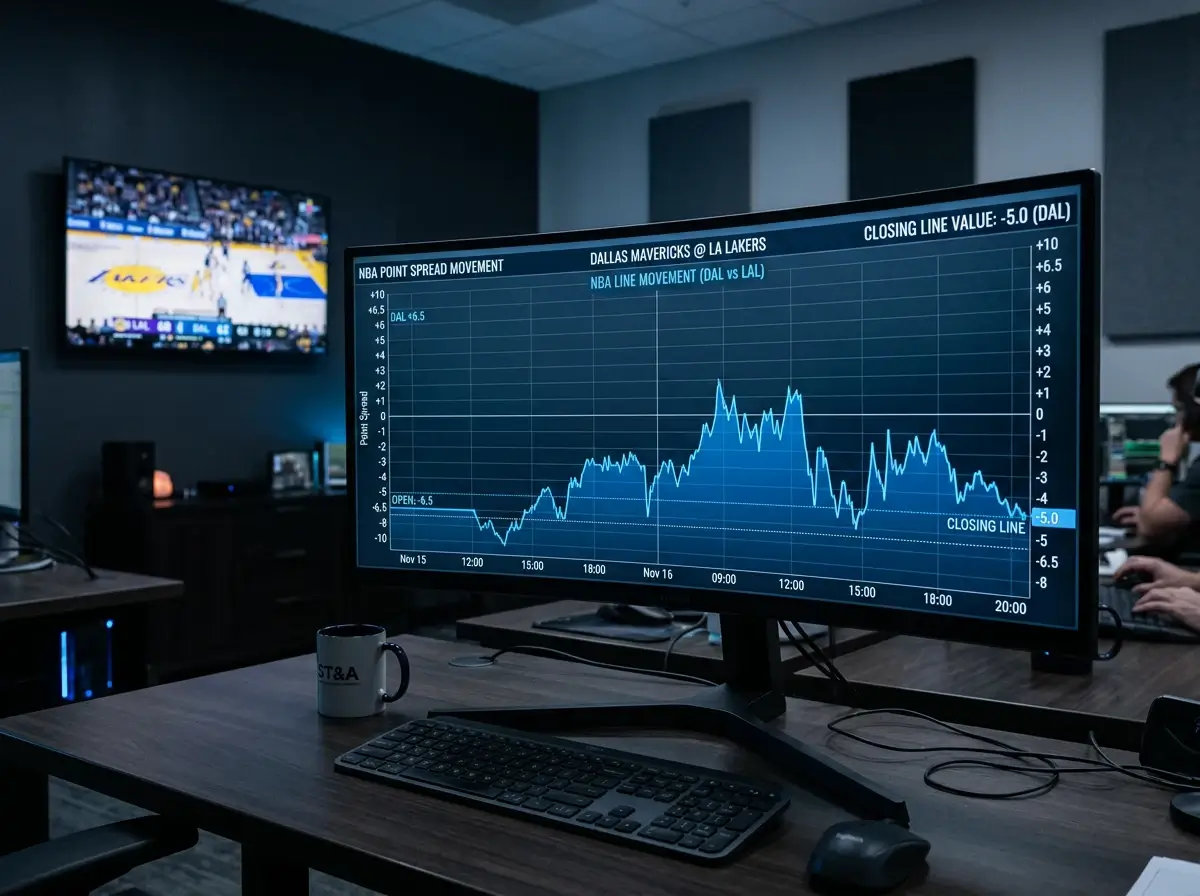
An NBA Line Opens Hours Before Tip-Off and Moves Constantly — Every Shift Contains Information
I once watched a line move from -3.5 to -6 in under ninety minutes on a regular-season Bucks game. No injury had been announced. No breaking news. The public betting percentages showed 55% of bets on the other side. Something was happening that the surface data could not explain, and that “something” was sharp money — large, informed bets from professional bettors or syndicates that the bookmaker respects enough to move the number. The Bucks won by twelve that night. The line had been right all along. See also betting tips basketball nba for the complete NBA betting tips guide.
NBA lines are not fixed prices — they are living markets that respond to supply and demand. When a bookmaker posts an opening line in the morning, they are setting a price designed to attract balanced action on both sides. From that moment until tip-off, every bet placed shifts the number. Understanding why and how those shifts happen is the difference between betting into a smart market and betting against it. FanDuel controls roughly 39.6% of the regulated US handle and DraftKings another 35.3%, which means the line movements at these two operators alone reflect the vast majority of money flowing through the NBA betting market.
Why Lines Move: Handle Imbalance, Sharp Action, and Information Events
Adam Silver has spoken publicly about the NBA’s efforts to work with betting companies on additional controls to prevent manipulation. Those controls are important for integrity, but from a bettor’s perspective the daily mechanics of line movement are driven by three forces that have nothing to do with game-fixing.
The first is handle imbalance. If 75% of the money on a game lands on one side, the bookmaker faces lopsided liability. They move the line toward the popular side to attract action on the other. This is a mechanical adjustment, and it happens in most games. It does not necessarily mean the popular side is wrong — it means the bookmaker is managing risk.
The second is sharp action. Professional bettors place large bets at specific moments, often within seconds of the opening line or after an information event like an injury report. Bookmakers track which accounts consistently beat the closing line, and when those accounts act, the operator moves the number regardless of overall handle balance. A single sharp bet of ten thousand dollars can move a line more than five hundred public bets of twenty dollars each, because the bookmaker trusts the sharp’s information over the crowd’s sentiment.
The third is information events — primarily injury reports, lineup confirmations, and weather for outdoor sports. In the NBA, the most impactful information event is the game-day injury report, which now updates every fifteen minutes. When a key player’s status changes from “questionable” to “out,” the line moves immediately. Bettors who monitor these reports in real time can occasionally capture value in the gap between the announcement and the market adjustment, though that window has compressed to seconds at the most liquid operators.
Reading Line Movements: Steam Moves, Reverse Line Movements, and Dead Lines
Not all line movements are created equal, and learning to classify them is a skill that took me several seasons to develop with any confidence.
A steam move is a sharp, sudden shift — typically half a point or more within minutes — triggered by coordinated sharp action. These are the most informative movements because they represent money from bettors with a proven track record. When you see a steam move, the market is telling you that informed money disagrees with the current price. I do not blindly follow steam moves, but I do treat them as a strong signal that warrants investigation. If my own analysis agrees with the direction of the steam, I act. If it contradicts my analysis, I stay away rather than taking the other side.
Reverse line movement is subtler and more frequently misunderstood. It occurs when the line moves in the opposite direction of public betting. If 70% of bets are on Team A, but the line moves toward Team A — making them a worse price — it signals that the smaller volume on Team B carries more weight because it comes from sharper accounts. Reverse line movement is not a guaranteed indicator, but it is one of the strongest signals available for identifying where professional money sits.
A dead line is one that has not moved since opening despite heavy betting volume on one side. This usually means the bookmaker is comfortable with the number and the sharp accounts have not engaged. Dead lines are less interesting for bettors looking for line-derived edges, but they suggest that the market considers the opening number accurate — which is useful information in itself.
Closing Line Value: What It Is and How to Measure Your Edge
If you take away one concept from this entire article, make it this: closing line value is the single most reliable measure of whether your NBA betting strategy has a genuine edge.
The closing line is the final spread or total available at tip-off. It represents the most efficient price the market produces, because it incorporates all information — every injury report, every sharp bet, every handle shift — that accumulated throughout the day. If you consistently place bets at prices better than the closing line, you are capturing value that the final market does not offer. Over a large sample, beating the closing line correlates more strongly with long-term profit than win rate does.
Here is an example. You bet the Celtics at -4.5 in the morning. By tip-off, the line has moved to -6.5. Your bet is now two points better than the closing line — that is positive closing line value. It does not matter whether the Celtics win by exactly five (covering your bet but not the closing line) or lose outright. Over hundreds of bets, consistently getting better numbers than the close produces profit because you are systematically paying less than the market’s final assessment of fair value.
Tracking closing line value requires recording the line at the time you placed the bet and the closing line at tip-off for every single wager. It is tedious, and most bettors skip it. That is precisely why the bettors who do track it have an informational advantage — they know whether their edge comes from skill or luck, and they can adjust their approach accordingly. A bettor with a 55% win rate but consistently negative closing line value is running hot and will regress. A bettor with a 50% win rate but consistently positive closing line value has a genuine edge that variance has temporarily masked.
Line Movement as a Diagnostic, Not a Strategy
The temptation is to build a system around line movement alone — “follow the steam,” “always take the reverse line movement,” “beat the closing line by two points or do not bet.” I have tested each of these as standalone approaches, and none produced sustained profit. Line movement is diagnostic information: it tells you what the market is doing and why. It does not tell you what the correct answer is.
Where line movement becomes powerful is as a confirmation layer. If your independent analysis points to one side and the line movement supports it, your confidence should increase. If the line is moving hard against your position and you cannot explain why, that is a signal to pause, investigate, and potentially abandon the bet. The worst outcome is betting against sharp money on a hunch and calling it “contrarian.” Contrarian betting only works when you have a reason the sharps are wrong. Without that reason, you are just on the wrong side of the market. See also expected value betting using closing line data.
What causes an NBA line to move after opening?
Lines move due to three main forces: handle imbalance where too much money lands on one side, sharp action from professional bettors whose accounts the bookmaker respects, and information events such as injury report updates. Sharp action is the most informative movement because it reflects assessed edge rather than public sentiment.
How do I calculate my closing line value on NBA bets?
Record the odds and spread at the time you place each bet, then note the closing line at tip-off. If you bet a team at -4.5 and the line closed at -6, you captured 1.5 points of positive CLV. Track this across all bets. Consistently positive CLV over a sample of 200+ bets is the strongest indicator of long-term profitability.
What is reverse line movement in NBA betting?
Reverse line movement occurs when the spread moves opposite to the direction of public betting. If most bets are on Team A but the line moves to make Team A a worse price, it signals that sharp money on Team B outweighs the public volume on Team A. It is one of the strongest indicators of professional positioning.
This material was created by the CourtEdge team.
Related posts

NBA Betting Advertising Regulation: How UK and US Rules Affect What Punters See
NBA Team Betting Trends: ATS Records, Cover Rates, and Where to Find Persistent Edges