
NBA Parlay Betting: Accumulator Maths, Same-Game Parlays, and When to Avoid Them
 Available in US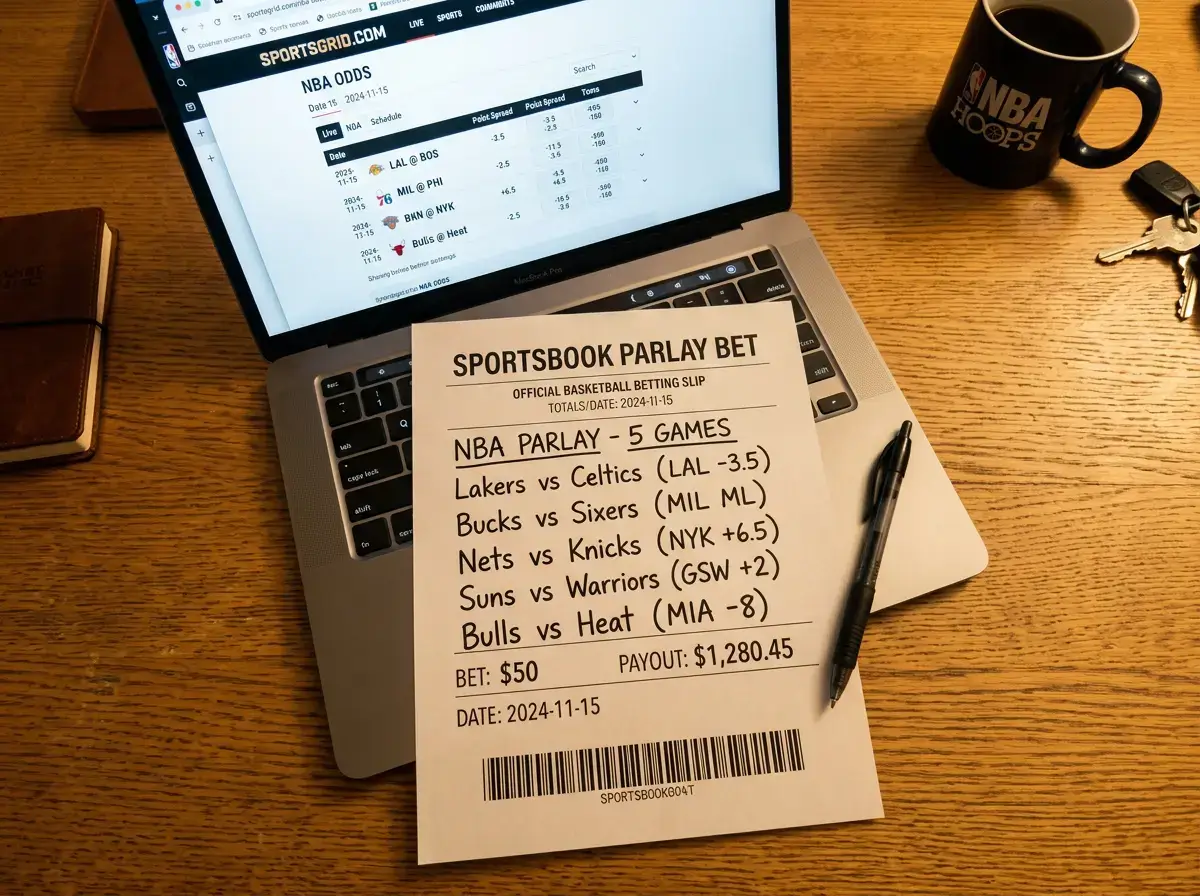
Parlays Generate the Highest Margins for Bookmakers — Understanding Why Is the First Step to Using Them Wisely
I placed my first NBA parlay on the same night I opened my first betting account. Five-leg accumulator, five moneyline favourites, payout of roughly eight to one. It felt like free money right up until the fourth leg collapsed when the Clippers blew a twenty-point lead in the fourth quarter. That was nine years ago and I still remember the specific game — which tells you something about how parlays lodge themselves in your memory even when the maths says you should have known better. See also betting tips basketball nba for the complete NBA betting tips guide.
The NBA generates more than $160 million annually from its betting partnerships alone, and parlays are a central reason why the industry can afford those deals. Multi-bet products carry margins that dwarf single-bet markets. A standard NBA spread bet carries a bookmaker margin of roughly 4.5%. A four-leg parlay on the same spreads compounds that margin to somewhere between 15% and 20%. The more legs you add, the wider the gap between what the bookmaker pays and what a fair-odds parlay would return. Bookmakers promote parlays aggressively — through push notifications, enhanced-odds specials, and bet-builder tools — because they are the highest-margin product in the shop.
None of this means parlays are always wrong. But it does mean that every NBA parlay you place starts at a mathematical disadvantage that grows with every leg, and you need to understand exactly how that disadvantage works before deciding whether the potential payout justifies it.
Accumulator Maths: How Overround Compounds Across Legs
The overround is the bookmaker’s built-in profit margin on any market. On a standard NBA spread, each side is typically priced at 1.91 decimal (the equivalent of -110 in American odds). The implied probabilities of both sides sum to 104.7% — the extra 4.7% is the overround. On a single bet, that margin is manageable. On a parlay, it multiplies.
Take a two-leg parlay at 1.91 per leg. The fair combined odds would be 3.65 (1.91 x 1.91), but the bookmaker’s payout reflects 3.65 minus the compounded margin. By the time you reach four legs, the effective overround exceeds 18%. At six legs, it can approach 30%. You are not just paying the bookmaker’s margin once — you are paying it on every leg, and each payment reduces your expected return from the total.
I ran this calculation on every NBA parlay I placed during the 2022-23 season — forty-seven parlays in total, ranging from two to five legs. My hit rate was 23%, which sounds dismal but was actually above the expected hit rate for those leg counts. Despite that, I finished the season negative on parlays by roughly twelve units. The margin ate the edge. When I switched the same selections to flat singles the following season, the same picks produced a small but positive return.
The lesson is not complicated. Parlays do not make bad picks good. They make good picks worse by layering margin on top of margin. The psychological appeal — the large potential payout — masks the mathematical reality that you are paying a premium for the excitement of combining selections.
Same-Game Parlays in the NBA: Correlation, Pricing, and the House Edge
Same-game parlays — SGPs — have become the most heavily marketed product in NBA betting. The concept is straightforward: combine multiple selections from the same game into a single bet. You might pair “Team A to win” with “Player X over 24.5 points” and “Total over 215.5.” The payout looks attractive because the bookmaker treats each leg as semi-independent and multiplies the odds accordingly.
The problem is correlation. If Team A wins, their star player is more likely to have played well and scored heavily — which means “Team A wins” and “Player X over 24.5 points” are not independent events. The bookmaker’s SGP engine adjusts for some of this correlation, but the adjustments are opaque and typically favour the house. You cannot see the model. You cannot verify the correlation assumptions. You are trusting the bookmaker to price correlation fairly, and the bookmaker has no incentive to do so.
The integrity dimension matters here too. In October 2025, the FBI arrested more than thirty individuals connected to the NBA on charges including illegal betting and exploitation of confidential player information. Part of what made those schemes possible was the granularity of prop markets that feed into SGPs — individual player stats that can be influenced by decisions invisible to the public. The 2025 scandal did not eliminate SGPs, but it underlined how vulnerable individual-performance markets are to manipulation, and any product built on top of those markets inherits that vulnerability.
I do not use SGPs. The correlation pricing is a black box, the margins are steep, and the integrity risk on the prop components adds a layer of uncertainty that I cannot quantify. If I like a spread and a total in the same game, I bet them as two singles. The combined margin is lower and the transparency is total.
When Parlays Have a Role: Correlated Legs and Low-Vig Markets
After all of that, are parlays ever justifiable? In narrow circumstances, yes — but only when you can identify genuine positive correlation between legs that the bookmaker has not fully priced.
The clearest example in the NBA is a totals-spread parlay. If you believe a game will be high-scoring because both teams play at an above-average pace, the team with the better offence is more likely to win in a shootout. “Team A moneyline + over 225.5” is a positively correlated parlay — both legs become more likely if your underlying thesis (high pace, high scoring) is correct. The bookmaker adjusts for some of this in SGP pricing, but a cross-game parlay combining two separate high-total games may not receive the same correlation adjustment.
Another defensible use is a small-stake, two-leg parlay as a bankroll-efficient way to express a strong conviction. If you believe two games offer genuine value and you want to concentrate your exposure, a two-leg parlay limits your risk to a single unit while offering a larger payout than two separate one-unit bets. The margin penalty on a two-leg parlay is modest — roughly 9% versus 4.5% on a single — and if your conviction is high enough, the trade-off can be acceptable.
Beyond two legs, I do not see a mathematical case for parlays in NBA betting. The margin compounding overwhelms any edge you might have, and the psychological pull of large payouts encourages impulsive betting that contradicts every principle of disciplined wagering. Treat parlays as a recreational side bet with a fixed, small budget — never as a core strategy. See also NBA totals and over/under for parlay legs.
What are same game parlays in NBA betting?
Same-game parlays combine multiple selections from a single NBA game into one bet — for example, a team to win, a player to score over a certain number of points, and the total to go over. The bookmaker’s engine prices each leg and adjusts for perceived correlation between them, though these adjustments are opaque and typically favour the house.
Why do bookmakers promote NBA parlays so heavily?
Parlays carry significantly higher margins than single bets. The bookmaker’s overround compounds with every leg added — a four-leg parlay can carry an effective margin of 15-20% compared to roughly 4.5% on a single. This makes parlays the most profitable product for operators, which is why they invest heavily in promoting them through apps, push notifications, and enhanced-odds offers.
Are correlated NBA parlays ever a smart bet?
In narrow circumstances, yes. If two legs of a parlay become more likely when the same underlying condition is true — such as a high-pace game favouring both the over and the team with the better offence — the positive correlation can offset some of the margin penalty. Two-leg correlated parlays are the most defensible; beyond two legs, the compounding margin typically overwhelms any edge.
This material was created by the CourtEdge team.
Related posts

NBA Betting Advertising Regulation: How UK and US Rules Affect What Punters See
NBA Team Betting Trends: ATS Records, Cover Rates, and Where to Find Persistent Edges