
NBA Bankroll Management: Unit Sizing, Drawdown Limits, and Season-Long Budgeting
 Available in US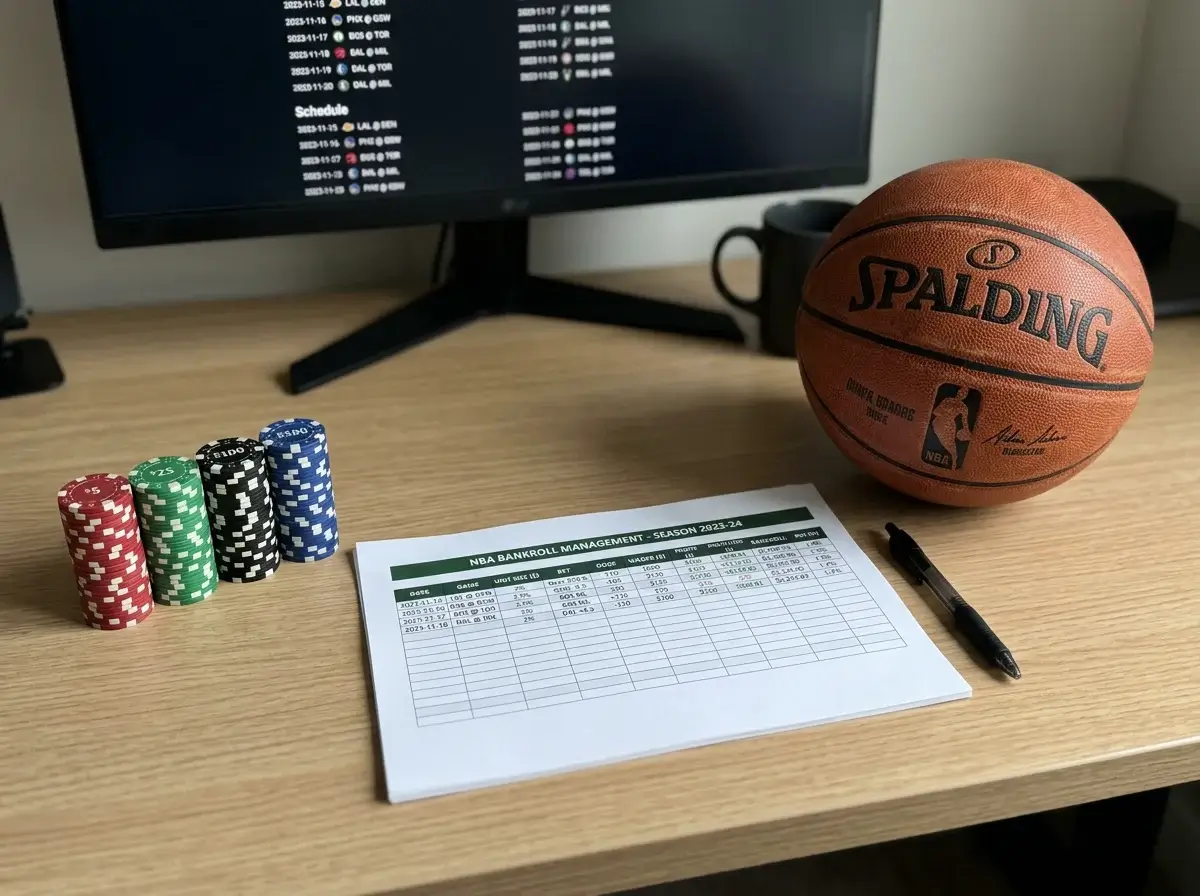
Most NBA Bankroll Advice Stops at “Bet 1–5%” — That Is Not a Model, It Is a Guess
Every NBA betting guide on the internet includes the same bankroll advice: bet one to five percent of your bankroll per game. The range is so wide that it is practically meaningless. On a one-thousand-pound bankroll, one percent is ten pounds and five percent is fifty — a fivefold difference that would produce completely different outcomes over an eighty-two-game season. Telling someone to bet between ten and fifty pounds per game is like telling someone to drive between thirty and a hundred and fifty miles per hour. The instruction covers so much ground that it offers no actual guidance. See also betting tips basketball nba for the complete NBA betting tips guide.
In 2025, US sportsbooks processed $165.58 billion in handle — and the vast majority of that came from bettors who have no formal staking plan at all. They bet what feels right, increase when they are winning, chase when they are losing, and wonder why their bankroll disappears in January. A staking plan is not a luxury. It is the structural foundation that determines whether your analysis has a chance to compound over a full NBA season or gets buried under drawdowns that your emotional discipline cannot absorb.
Unit Sizing for an 82-Game Season: Flat, Percentage, and Confidence-Tiered Models
A unit is a standardised bet size that removes emotion from the staking decision. How you define a unit determines how your bankroll responds to winning and losing streaks, and there are three primary models worth understanding.
Flat staking is the simplest: every bet is one unit, regardless of perceived edge. If your bankroll is five hundred pounds divided into fifty units, every bet is ten pounds. Wins and losses accumulate linearly. The advantage is discipline — you cannot talk yourself into betting three units on a game because you “feel strongly.” The disadvantage is that you weight every bet equally, even when your analysis says some games offer far more edge than others.
Percentage staking ties your unit to a fixed proportion of your current bankroll. If you bet 2% of a five-hundred-pound bankroll, your first bet is ten pounds. Win five bets and your bankroll rises to roughly five hundred and forty-five — your next bet is ten pounds ninety. Lose five and your bankroll drops to roughly four hundred and sixty — your next bet is nine pounds twenty. The advantage is that your bet size scales with your bankroll, automatically reducing stakes during drawdowns and increasing them during hot streaks. The disadvantage is calculation friction — you need to know your current bankroll before every bet.
Confidence-tiered staking assigns one, two, or three units based on your conviction level. A standard play gets one unit. A game where your model shows a large discrepancy between your projected line and the bookmaker’s posted line gets two units. A game where that discrepancy is confirmed by multiple independent signals — line movement, injury impact, and situational spot — gets three units. The advantage is capital efficiency: you concentrate your exposure where your edge is largest. The disadvantage is that self-assessed confidence is a poor proxy for actual edge, and most bettors overrate their conviction on the games they are most excited about rather than the games they have analysed most rigorously.
I use a modified flat stake. Every bet is one unit, with a maximum of two units reserved for games where my expected value calculation shows an edge of 5% or greater. In nine years, I have placed a two-unit bet fewer than thirty times per season. The constraint is intentional — it forces me to treat every bet as equal in process even when my gut says otherwise.
Applying the Kelly Criterion to NBA Markets: Full Kelly, Half Kelly, and Quarter Kelly
The Kelly Criterion is a formula that calculates the optimal bet size based on your edge and the odds offered. The formula is: (bp — q) / b, where b is the decimal odds minus one, p is your estimated probability of winning, and q is the probability of losing (1 — p). If the result is positive, you have an edge and the formula tells you what fraction of your bankroll to wager.
On paper, Kelly is elegant. In practice, it is dangerous for NBA bettors — and I say this as someone who tried full Kelly for a single month in 2020 before abandoning it. The problem is that Kelly assumes your probability estimates are perfectly calibrated. They are not. If you overestimate your edge by even two or three percentage points, Kelly recommends a bet size that can produce ruinous drawdowns. An NBA bettor who estimates a 56% probability on a spread bet at 1.91 odds gets a Kelly recommendation of roughly 6% of bankroll. If the true probability is 53%, that 6% bet is oversized, and a losing streak of eight to ten games — which happens to 53% bettors routinely — can wipe out 40% of the bankroll.
Half Kelly and Quarter Kelly reduce the recommendation proportionally. Half Kelly on the same bet would suggest 3% of bankroll; Quarter Kelly would suggest 1.5%. These fractional approaches preserve the Kelly framework’s logic — bet more when your edge is larger — while dramatically reducing the drawdown risk that comes from imprecise probability estimates. Most professional sports bettors I have spoken with use something in the Quarter to Half Kelly range, and several have told me they would not recommend full Kelly to anyone who is not running a verified, backtested model with calibration data spanning thousands of bets.
Drawdown Rules: When to Reduce Stakes and When to Stop
Roughly 47% of UK adults gamble in some form, and the ones who survive long-term in sports betting are the ones who have a plan for losing streaks — not just winning streaks. A drawdown rule is a predetermined response to a declining bankroll that removes the emotional decision from the equation.
My drawdown framework has three thresholds. At a 15% drawdown from my season-starting bankroll, I reduce my standard bet to half a unit. This is a signal that either variance is running against me or my analysis has a leak — either way, reducing exposure is the correct response. At a 25% drawdown, I stop betting for one week and review every bet placed during the drawdown period. I look for patterns: am I overweighting one market type? Am I betting games I would normally pass on? Am I chasing? At a 40% drawdown, I stop for the remainder of the month and do not resume until I have re-evaluated my entire approach.
The numbers are not sacred — you can set your own thresholds. What matters is that the thresholds are set before the season starts, written down, and non-negotiable. The moment you negotiate with a drawdown rule during a losing streak is the moment it stops protecting you. See also common betting mistakes that hurt your bankroll.
What is bankroll management in NBA betting?
Bankroll management is the practice of setting a fixed betting budget, dividing it into standardised units, and following a staking plan that determines how much to bet on each game. The goal is to survive losing streaks, protect your capital during drawdowns, and allow your analysis to compound over a full NBA season rather than being wiped out by short-term variance.
How many units should an NBA betting bankroll contain?
Fifty units is a common starting point — enough to absorb a losing streak of ten or more bets without depleting the bankroll, while keeping individual bets large enough to feel meaningful. More conservative bettors use 100 units; more aggressive approaches use 30-40. The key is choosing a number that lets you endure realistic variance without emotional decision-making.
What is a safe maximum drawdown for an NBA betting season?
A drawdown of 15-20% should trigger a stake reduction. A drawdown of 25-30% should trigger a betting pause and full review. Beyond 40%, most bettors should stop for the month and reassess their entire approach. These thresholds should be set before the season starts and treated as non-negotiable rules rather than guidelines.
This material was created by the CourtEdge team.
Related posts

NBA Betting Advertising Regulation: How UK and US Rules Affect What Punters See
NBA Team Betting Trends: ATS Records, Cover Rates, and Where to Find Persistent Edges